The Pleiades by Ivan Bunin

It’s dark. Not caring where I go, which path I follow,
Past sleepy ponds I stroll.
Of autumn freshness, leaves and fruit the fragrance mellow
Drifts over all.
The garden’s almost bare, and through the branches whitely
The stars of evening show.
Dead silence reigns. Murk clothes the paths. It’s nighttime.
My steps are slow.

They’re slow, but wake the hush… High in the sky’s cool
darkness,
A princely diadem,
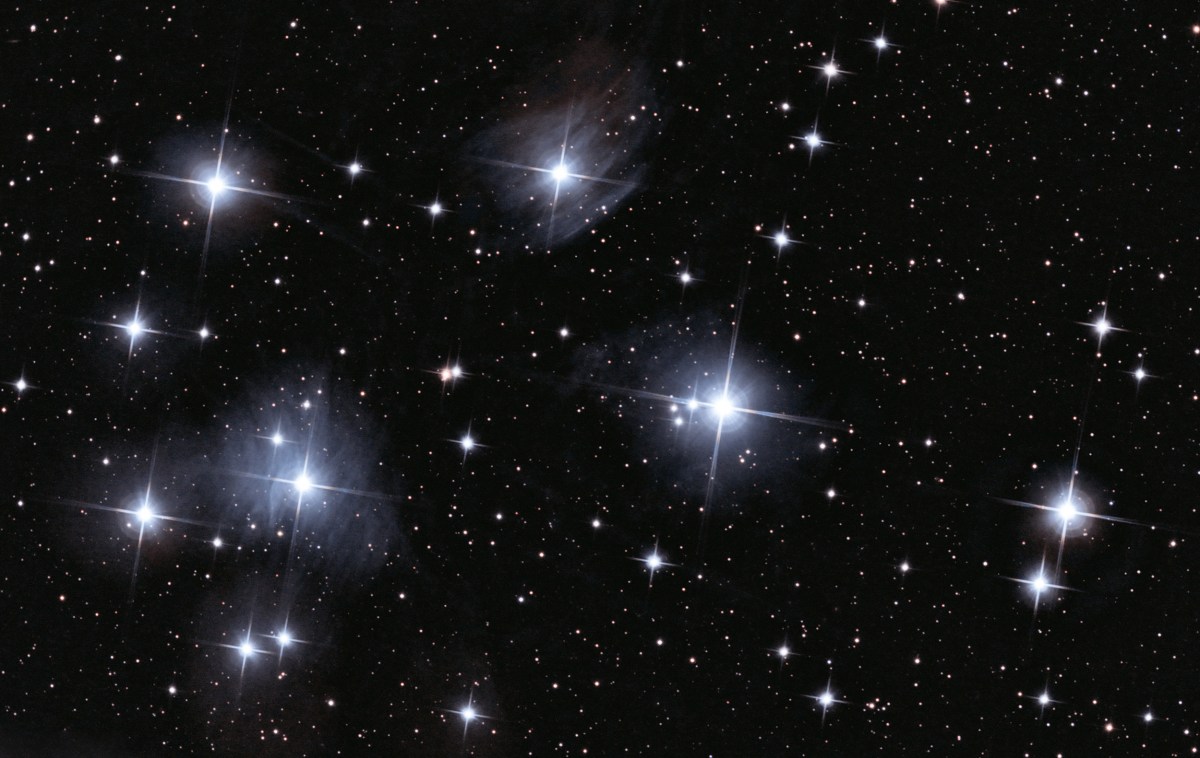
The icy Pleiades blaze diamond-like and sparkle,
Each one a gem.

On its face, “The Pleiades” by Nobel Prize-winning Russian author Ivan Bunin (translation from All Poetry) contains an inspirational (and somewhat unoriginal) message: when life seems dark, confusing, and/or pointless, look at the stars, and their transcendent light will lead you to your spiritual home. Continue reading →
Links We Loved This Week — 5/13/16

Last week we rounded up some of the pre-finale coverage of the end of the The Good Wife, one of the shows we’ve been recapping since we started this blog in September. Here are some of our favorite reactions to the finale:

  • Emily Nussbaum at The New Yorker, like us, thought it was a flawed episode but liked the“rich, dizzy darkness of the last few minutes.”
  • The NYT wrote that Julianna Margulies’ acting saved any flaws in the finale.
  • The Fug Girls hated the ending: “Instead, I wondered, both of this hour and of the last seven years, ‘Is that all there is?’”
  • The Atlantic analyzed all the ways in which the show came full circle at its ending–not just The Slap, but that too.
  • At EW, Melissa Maerz asks, “Does wanting closure from The Good Wife make you dumb?” (I’d say no, maybe not, but I do still disagree with the dismissal of the ending.)

Someone has been telling a surprisingly well-written cosmic horror story (more like SCP than anything else) in comments to mostly-unrelated reddit threads. This is a page that collects and organizes the story so far.

Huffpo summarizes the legacy of Jane Jacobs, who would have turned 100 this week.

The Emily Dickinson Museum is resurrecting the poet’s infamous orchard and gardens, via the NYT.

Nashville 4×18: “The Trouble with the Truth”

­­­­­­Previously on Nashville: People didn’t want to play Will on the radio because he was gay; Maddie filed for emancipation; Rayna threatened Cash; Scarlett and Gunnar got stuck in an elevator and then made out; Juliette asked for another chance with Avery, but he made out with Layla instead.

Rayna is getting ready for court. It’s an intense process, involving brow pencil and everything. “You are a good mother,” Deacon tells her as he puts on his suit. He says that Cash is pulling the wool over Maddie’s eyes, but that “no judge is going to rule in favor of a sixteen-year-old runaway.” For the sake of sixteen-year-olds who have actual abusive parents, I hope that dismissive statement is not true. Both parents look sad and worried.

Continue reading →

Peter and Wendy by J.M. Barrie

…every spring cleaning time, except when he forgets, Peter comes for Margaret and takes her to the Neverland, where she tells him stories about himself, to which he listens eagerly. When Margaret grows up she will have a daughter, who is to be Peter’s mother in turn; and thus it will go on, so long as children are gay and innocent and heartless.

“Gay and innocent and heartless” is the perfect last line for J.M. Barrie’s classic novel about never growing up, because children can’t understand it. When I read this line as a child, it nagged at me for years, because I couldn’t reconcile the apparent contradiction. Innocence is the epitome of goodness, or so I thought.

But once I, like Wendy, betrayed Peter Pan by growing older, and reread the novel as an adult, the conclusion made perfect sense. Peter is the embodiment of guilelessness and joyfulness, and so is relentlessly charming, but is also terminally selfish. Innocence is unsustainable unless it is accompanied by a pure self-centeredness, which is why we never blink an eye when Peter forgets Wendy for decades, or is tempted to stab Wendy’s little daughter, Jane, shortly before the end. He wants to eliminate this child out of resentment, because she symbolizes the passage of time that has taken Wendy away from him, and reminds him of the reality that he would prefer to reject. But he doesn’t mean anything by it.

So what better day to celebrate this author than the ultimate symbol of the passage of time: his birthday. Happy 156th birthday, J.M. Barrie!

Why I Loved The Good Wife Finale: Recap & Review

This is it! In its final episode, The Good Wife rose out of the ashes of a mess of a season and grasped at the character-driven brilliance it had in its heyday. Before that, it attempted to make sense of a character whose contradictions, changes, and choices were opaque to her and wonderfully complex on screen.

I’ll recap it, then follow up with final thoughts—a farewell to this flawed masterpiece of a show.

Continue reading →

The Huntsman: Winter’s War Is a Movie, and These Are Things That Happen In It

I’ve never seen a movie quite like The Huntsman: Winter’s War. Don’t get me wrong, it’s a truly terrible movie, one of the worst I’ve ever seen. But if nothing else, it’s a true marvel of innovation. It’s the only movie I’ve ever seen that is a prequel, and also a sequel, and also manages to retcon the entire first movie. It stars Jessica Chastain, Emily Blunt, and Charlize Theron, and is damn near unwatchable (unless you’re laughing through the entire thing, as the Adversion writers were). And it’s so stupid, that in order to make fun of it, all you have to do is literally describe what happens. Little to no editorializing necessary.

So here goes: Continue reading →

Links We Loved This Week — 5/6/16

In the LA Review of Books, GD Dess holds up the failure of Purity as evidence that Jonathan Franzen is part of kitsch culture.

The tale at this juncture finally transmogrifies from a so-called realistic social novel into a novel of what James Wood has called “hysterical realism,” in which the conventions of realism are not abolished but, “on the contrary, exhausted, and overworked.” …Franzen has abdicated his writerly duty, and this dereliction demonstrates a certain authorial contempt for his readers.

Turns out Walt Whitman was really into “manly health” and cutting down on carbs way before it was cool.

Person of Interest executive producer Jonathan Nolan doesn’t just believe that Facebook will destroy the world, he takes it as a given (via AV Club):

A lot of things that Samaritan espouses are believed by the people who work for Samaritan, the same way that I’m sure people who work for Facebook don’t believe that they’re working for the company that will destroy the world. But, you know, they are. And everyone gets through the day rationalizing their own existence.


As you may know, The Good Wife will have its final episode this Sunday. Here are some of the best articles and interviews making sense of its incredible first few seasons, and (by almost all accounts) its struggling seventh:

  • Alan Sepinwall at HitFix takes a look at The Good Wife as the last prestige network drama. “no show has dealt with the struggle to defy societal expectations and keep one’s feelings under tight wraps as often, or as well, as The Good Wife,” he writes. (Ignore the part where he says that Parenthood was a rival for this show. I just watched the whole thing. It wasn’t.)
  • Salon jumps on the “there will never be a great broadcast drama after The Good Wife” bandwagon.
  • At the New York Times, Christine Baranski has a very surprising favorite scene from the show; Michael J. Fox and other cast members also weigh in.
  • Also in the NYT, James Poniewozik writes a good-bye-Good-Wife article notable for describing Jason as a “laconic, bearded sex cowboy.”
  • The Kings looked back at the show. Robert King says, “On our show, no one’s really shooting at each other. Their words are the guns.”

Nashville Recap: 4×17 “Baby Come Home”


This was an amazing episode. There were no filler scenes, which is usually a big problem; every scene was meaty and moved the plot line forward; many storylines came to well-deserved climaxes that have been coming for a long time; every major character had sympathetic motivations, even when they were at odds; and it was genuinely heartbreaking in several spots. Solid work, Nashville.

Continue reading →

When Men Write Women: Success Stories

I think of a man, and take away reason and accountability.

Jack Nicholson, As Good As It Gets

I’ve had dozens of moments when I’m reading an otherwise great book and a woman says something, or does something, that jolts me out of the world I’ve been inhabiting and reminds me that the author has his own particular notions of women, and not necessarily correct ones. From female characters who fulfill some male fantasy of what women should be like (hot, mostly), or who have no depth at all beyond their looks, to those who have one highly stereotypical personality trait whereas male characters are fully-rounded: the sins committed by authors of all stripes against female characterization are varied, and unfortunately, still frequent.

Sometimes it seems that the feminist internet has rightly given up on even encouraging men to write women at all; if we want a great female character, we assume we’ll need to read Chimamanda Adichie, Willa Cather, Claire Messud. But every once in awhile, a gifted male writer will come along who has an understanding of the unique power structures that affect women, but also is capable of infusing the same vision of humanity into his female characters as he does into his male characters. Here are a few of my favorite female characters written by men. Comment below to share your favorites! (Or to rant about the worst failures. We love rants here at Adversion.)

Aaliyah Saleh, An Unnecessary Woman – Rabih Alameddine

The inspiration for this post, Aaliyeh is the mid-seventies woman with blue hair who narrates Rabih Alameddine’s novel.

Continue reading →