“Faustine” by Algernon Charles Swinburne

You have the face that suits a woman
      For her soul’s screen —
The sort of beauty that’s called human

      In hell, Faustine.

The meaning of the name Faustine is “made of the stuff of Faust,” just as Eve was made from the rib of Adam and Pandora at the hands of Hephaestus. By Swinburne’s own admission, Faustine’s unearthly beauty signals a missed opportunity for exaltation, a gift she squanders “to waste the loves and ruin the lives of men.”
The poem is concerned with one central idea, he says:

“…the transmigration of a single soul, doomed as though by accident from the first to all evil and no good, through many ages and forms, but clad always in the same type of fleshly beauty.”

And she has taken many forms through the ages, both in mythology and in literature. The gorgeous Faustine who is caressed by dishonest serpents and receives “flower of kisses without fruit of love”–she could be Daisy Buchanan, or Rosamond Vincy, or even Lily Bart. The awareness that beautiful, hollow monsters are made, not born, varies in each of these works, but there is virtually none in Swinburne’s (otherwise quite moving) poem.
You seem a thing that hinges hold,
      A love-machine
With clockwork joints of supple gold —
      No more, Faustine.

A family-piece

A great moment from Jane Austen’s Persuasion:

Immediately surrounding Mrs Musgrove were the little Harvilles, whom she was sedulously guarding from the tyranny of the two children from the Cottage, expressly arrived to amuse them. On one side was a table occupied by some chattering girls, cutting up silk and gold paper; and on the other were tressels and trays, bending under the weight of brawn and cold pies, where riotous boys were holding high revel; the whole completed by a roaring Christmas fire, which seemed determined to be heard, in spite of all the noise of the others. Charles and Mary also came in, of course, during their visit, and Mr Musgrove made a point of paying his respects to Lady Russell, and sat down close to her for ten minutes, talking with a very raised voice, but from the clamour of the children on his knees, generally in vain. It was a fine family-piece.

In noticing what a lovely scene the family makes, the narrator steps back to a frame of observation that parallels ours as readers—admiring the artistry with which the scene was assembled—such that the statement can’t quite be distinguished from Austen reflecting approvingly on herself. It’d be insufferable, of course, if the scene weren’t perfect, but it is, and the flourish sits gently on top: “a fine family-piece.”

Vincent Van Gogh’s “Long Grass with Butterflies”


“Long Grass with Butterflies” was painted at the end of Van Gogh’s stay at the Saint-Paul Asylum, since renamed the Clinique Van Gogh. In his letters, he described the “abandoned gardens” depicted in the painting, in which “the grass grows tall and unkempt, mixed with all kinds of weeds.”

We cannot speculate about his mental or emotional state, but the fact that these “abandoned” gardens are behind an asylum is poignant and telling in itself. Van Gogh’s characteristically vibrant colors are underscored with a discordant black, and the eponymous black-outlined butterflies are beautiful when found, but are nearly lost in the chaotic, kinetic landscape.

The viewer of the garden is looking downwards, limited to a perspective that is quite literally depressed. Beyond the long, untended grass we can see a thin, faraway footpath with an unseen destination, as well as the beginnings of trees that are abruptly cut off. The world has become very small, this tells us–small and loud with tantalizing signs of an expansive elsewhere just outside of our field of vision.

Nashville Recap: 4×10 “We’ve Got Nothing But Love to Prove”


Previously on Nashville: Scarlett and Caleb fought because of their long-distance woes; Colt ran away from Luke because he was done pretending; Wade Cole told Will his fans didn’t like Will’s lifestyle; Rayna told Markus that Deacon was her guy (because Deacon was being a huge fucking baby) and signed Maddie and Daphne; Avery got full custody of Cadence; and Juliette went to rehab, but Emily didn’t tell Avery.

At a big field, setup is underway for a concert while Rayna and Bucky pedeconference. Bucky’s a bit worried about Markus ending up with a half-empty lawn. A young woman with a headset comes up to tell them that even though Rayna sent Markus off to get wired for sound, he never showed. “What?” Rayna says, utterly shocked that Markus would not show up somewhere he was expected to show up, because she has learned nothing in the past three months.

Continue reading →

Retro Recap: Keeping up with the Kardashians

So, it is probably fairly obvious if you follow this blog that Keeping up with the Kardashians is not the kind of show that any of us at Adversion would normally be watching. But my friend S. is turning twenty-nine tomorrow, so I am—at her request—writing a recap of an episode of her favorite show. Funnily enough, in this episode, being twenty-nine is a huge plot point—and I honestly had no idea until I’d started watching it.

Well, here goes. Happy birthday, S.!

Continue reading →

The Americans: America as the “Evil Empire”

The third season finale of The Americans, aptly titled “March 8, 1983,” ends with a quietly seething Elizabeth watching Reagan’s famed “Evil Empire” speech, which took a hard line against the Soviet Union’s nuclear missile installation and almost single-handedly escalated the Cold War. The episode included only a few of the most recognizable lines, ending on the fear-mongering mic drop: “…they are the focus of evil in the modern world.” But when reading the speech in full, it becomes clear that the meaning of its inclusion is multi-layered, as it precisely reflects the ideological conflict–and implicit critique of American culture–that is central to the show.

Continue reading →

The Good Wife Recap: 7×16 “Hearing”

Y’all probably know if you’ve read our other recaps that I will wholeheartedly approve of anything that involves Stockard Channing. She’s back in this episode—and so is our long-lost Owen! Hi, Owen—and I have to admit, all the shenanigans made me laugh as hard as I ever have at this show.

But were there, perhaps, too many shenanigans and not enough actual stuff? (Objection: leading question.)

 Previously on The Good Wife: Alicia and Jason made out. Cary and David Lee started running around like chickens with their heads cut off because they had developed a group hallucination that there was such a thing as an “all-female firm” and that Diane wanted to be that thing. Peter was in legal trouble, and it probably had to do with a rich donor, not with his vote-rigging, and thenceforth became boring to me. Elsbeth was brilliant yet unhinged and had an equally brilliant yet unhinged ex-husband. Oh, and there was this guy named Will Gardner who we have to try not to think about, in order to take seriously Alicia’s attraction to Jason. (By the way, I SAW JOSH CHARLES ON THE STREET THE OTHER DAY. It was everything.)

Continue reading →

Beauty is a Wound – Eka Kurniawan

So she let her stomach get bigger and bigger, held the selamatan ritual at seven months, and let the baby be born, even though she refused to look at her. She had already given birth to three girls before this and all of them were gorgeous, practically like triplets born one after another. She was bored with babies like that, who according to her were like mannequins in a storefront display, so she didn’t want to see her youngest child, certain she would be no different from her three older sisters. She was wrong, of course, and didn’t yet know how repulsive her youngest truly was.

Eka Kurniawan’s Beauty is a Wound takes place in the Indonesian city Halimunda, where a prostitute named Dewi Ayu lives through many decades of the turbulent twentieth century. It has a giant cast of vibrant, larger-than-life, sometimes-magical characters and a wide tapestry in terms of story and time, and its view of history is startlingly, centrally female. This romp of a book dwells on the crude, from piss and shit to sex, more often than on the sublime — but a New York Times review was rather inadequate when it described Kurniawan’s work as being merely about “unruly, untameable and often unquenchable desires.” Because it’s not just about desire; specifically, it features numerous, terrifyingly varied portrayals of rape. The beauty possessed by Dewi Ayu’s first three daughters, like “mannequins in a storefront display,” is not just a wound but a grave, ever-present danger for each of them.

I read the book as being “postcolonial” in the sense that it does examine the volcanic changes that take place in Javanese society after independence from the Dutch, from Japanese occupation to civil war; its topics range from law enforcement and local politics to the experiences of prisoners of war. But in the relations between male and female characters, the country’s violence and strife is replicated in miniature. So many men see their way clear to raping, to owning, to violating, some other woman. And each female character who is raped suffers as mightily as if she were an entire country unto herself.

It’s a fascinating, sometimes offensive read, and I’m still not sure I understand it fully, nor was I actually sure I enjoyed it. But as a book that has both the grandeur of García Marquez and the mordant scatological humor of Beckett, and is told in its own original, rambunctiously vulgar, yet beautiful voice, it is well worth a read.

Edgar Allan Poe’s “The City in the Sea”

But lo, a stir is in the air!
The wave- there is a movement there!
As if the towers had thrust aside,
In slightly sinking, the dull tide-
As if their tops had feebly given
A void within the filmy Heaven.

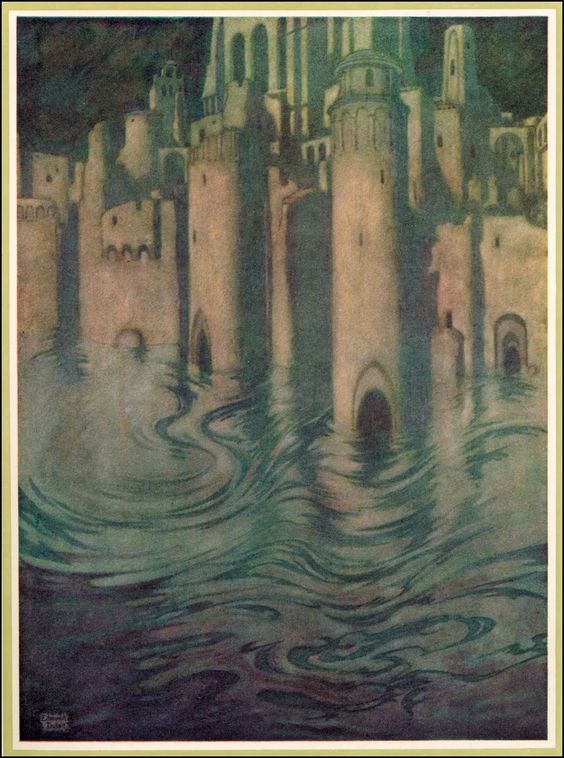
Poe’s “City in the Sea” refers to the city erected by Death, in which all lost souls, squandered riches, and fallen idols are laid to waste in “melancholy waters,” as Death looks “gigantically down” in satisfaction.

But these lines also tend to remind me of the metropolis in which kht, jd, and I reside: New York, of course. On its best days, the towering skyline ascends to the heavens and punctures them, sending their contents spilling down onto us. On its worst days:

Hell, rising from a thousand thrones,
Shall do it reverence.

The 100 Recap: 3×07 “Thirteen”

The 100 has shown us a ten-year-old girl committing cold-blooded murder, the romantic lead gunning down an entire village of innocents, and the protagonist wiping out an entire race of human beings, but this was still arguably the most controversial episode yet. It was also one of its best: “Thirteen” was a stunningly crafted hour of television, one that elegantly weaved all of the disparate plotlines of the season together and organically changed the entire mythology of the show without feeling like a retcon. It also happened to be a heartbreaking, elegiac origin story/farewell episode in the vein of season two’s “Spacewalker” (but for a much more popular and beloved character), and while a few elements of the execution may have been problematic, “Thirteen” will go down as one of the boldest moves in The 100‘s history.

All right, let’s get on with the recap. This is going to be a tough one. Continue reading →