Links We Loved This Week — 7/28/17

We link to Roxane Gay a lot… but that’s because she says such interesting stuff! This week, read her editorial on why she’s not going to bother watching a show about an alternate universe where slavery still exists. (Not that it’s the same thing AT ALL but her sentiments seem to be very similar to how I feel about movies with female sex robots.) (via New York Times)

Rebecca West was a brilliant modernist novelist, but she also apparently wrote a travel book about Yugoslavia that has fallen out of the fame it once held. I personally had never heard of it; it’s going on my to-read list after reading this passionate essay by James Thomas Snyder. (via LA Review of Books)

Sigourney Weaver said at Comic-Con that she based her villainous Defenders character on rich Trump supporters she knew in New York. She described these men in great detail, including the delightful quote: “Your objections to what they’re doing because of the planet makes them giggle secretly inside. They’re just like, ‘Oh yes, pish posh.’”
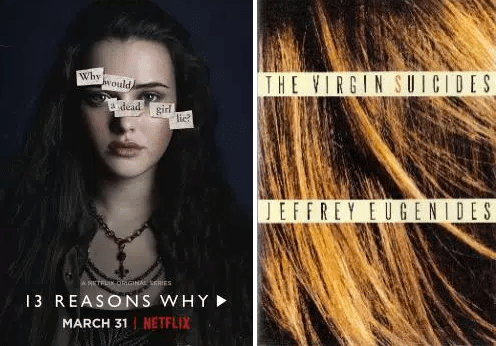
Subjectivity and the male gaze: in defense of that controversial scene in 13 Reasons Why

SPOILERS FOR 13 REASONS WHY ABOUND!

The controversies surrounding 13 Reasons Why have been numerous and well-enumerated; critics claim that the show glorifies teen suicide by presenting it as a suitable revenge for bullying, that portraying teen suicide at all (especially using attractive young actors) is irresponsible, and that Hannah’s rape scene is triggering for victims. But arguably the biggest point of contention is Hannah’s suicide scene, which is incredibly disturbing. It’s one thing to hear about a child slitting their wrists, it’s another thing altogether to see it happen in graphic detail.

But does the graphic nature of the scene automatically make it irresponsible? I’m not a mental health professional, so I can’t comment about whether the show is responsible about suicide on the whole. But in regards to this particular scene, I tend to agree with 13 Reasons Why writer (and suicide attempt survivor) Nic Sheff, who wrote in Vanity Fair that they included as much detail about the act of suicide as possible in order to shatter the “myth and mystique” surrounding suicide, and especially to “dispel the myth of the quiet drifting off.” For those who are worried that the show “glamorizes” suicide, if nothing else, that scene definitely showed viewers that there is nothing glamorous–or peaceful–about the act itself. Continue reading →

Everything new is old again

The Handmaid’s Tale, the novel written by Margaret Atwood, is a devastating and sui generis entry in the annals of dystopia, which stands alongside 1984 and Brave New World in the originality of its exploration of the psychology of a totalitarian society. The Handmaid’s Tale, the TV show being serialized on Hulu, is not.

The show so far is wonderfully acted, both from expected quarters (Elisabeth Moss) and… less-expected (Yvonne Strakovsky, Alexis Bledel). The direction is excellent, and the action is genuinely moving and traumatic. The third episode’s scene of a riot, filmed in slow motion, set to a vaporously slow cover of “Heart of Glass,” was truly haunting.

For all that, though, the show has lost the heart of what made the novel so brutal and revelatory.

Continue reading →

The Contradiction: Some Thoughts on Lilith’s Brood

Lilith’s Brood, a science fiction trilogy by Octavia Butler, tells a post- and pre-apocalyptic story, where a few humans survive a nuclear apocalypse only to face the end of their species in a very different way.

(Some spoilers after the cut, which I figure is probably OK since these books have been out in the world almost as long as I have.)

Continue reading →

Links We Loved This Week — 7/7/17

The New Yorker released the first English translation of Italo Calvino’s short story, “Adventure of a Skier.” We loved it, and wished that more New Yorker stories were as weighty yet enjoyable as this one.

The Onion‘s Spider-Man review (via Indiewire) hilariously objectified Tom Holland the way movie critic David Edelstein slobbered over Gal Godot. “Superbabe in the woods” will never be a thing.

Why is Jane Austen so popular? Big Data can give us the answer by analyzing her word choices. (via NYTimes)

Stephen Greenblatt wrote a powerful article for The New Yorker about how Shylock can teach tolerance even while exemplifying anti-Semitism.

Have you read Roxane Gay’s book Hunger yet? If you weren’t already planning on reading it, we dare you to read this adapted excerpt in The Guardian and not put it on your Amazon wish list.

The end of the world

Liu Cixin’s space-opera trilogy Remembrance of Earth’s Past revolutionized Chinese science-fiction, and creates a vision of the future as relevant and communicative as any in the history of the genre.

Liu’s avowed poetics for the work, at least as represented for English-speaking audiences, are given in an essay published in 2014, around when the first part of the the trilogy, The Three-Body Problem, was first translated. The essay concludes with his claim, “I wrote about the worst of all possible universes in Three Body out of hope that we can strive for the best of all possible Earths.”

The trilogy certainly takes a dark view of some of the ways humans relate to one another and to their world, but human nature is what Liu takes for granted: humans would act this way even in a Liebnitzian “best of all possible universes.” The “worst” universe Liu creates isn’t the human characters, it is the plot he embeds them in, which is so full of misfortunes that it borders on sadistic. Humans’ difficulties with one another and with their world are the subject that he wants to examine, and hopefully improve, if our actual universe turns out to be less awful than the fictional one he has drawn.

The center of the awfulness is the game-theoretic principle (invented by Liu) that gives the second book in the trilogy its title: Dark Forest Theory. Spoilers follow.

Continue reading →

Links We Loved This Week — 6/23/17

This woman has been slowly eating Infinite Jest for a year. We don’t really know why, but we support it.

If you, like us, are always just a few days behind on The Handmaid’s Tale, you may have missed Variety‘s fun, engaging interview with Elizabeth Moss about the finale.

Or, you might want to check out a pair of what I can only describe as cerebral fanwanks about hair and music in The Handmaid’s Tale at LA Review of Books.

Damon Lindelof might be doing a Watchmen series on HBO! And before you get upset, Zack Snyder he is not. He did wonders with The Leftovers by departing from the source material in meaningful ways.

This is the best tweet about the news, which came out right around the time Lord and Miller dropped out of the Han Solo prequel:


At Book Riot via The Millions, five writers inspired by Octavia Butler, whose birthday was Thursday, write about her influence on them. I happen to be in the middle of Fledgling and I’m loving it, so it’s a timely topic for me!

Links We Loved This Week — 6/16/17

Do you know about the creepy surrealist Youtube star Poppy? This article about her is fascinating, but what really fascinated me was just watching her “I’m Poppy” video. (via Wired)

After some anxious sponsors backed away from the notorious Trumpian production of Julius Caesar, Alexandra Petri for the Washington Post cheekily identified reasons why pretty much no plays should be acceptable to sponsors. For example, in As You Like It, “Woman wandering in the woods to get away from the current regime is portrayed as some sort of hero.” VERY inappropriate.

Rebecca Solnit argues in Harper’s that the mythical Cassandra is the feminine inverse of The Boy Who Cried Wolf: from Anita Hill to Cosby’s victims to Trump’s accusers and in countless other examples, men can lie over and over again and be believed, while women can tell the truth time and time again and be dismissed.

A poet who wasn’t getting any traction on Instagram conducted a social experiment in which he posted the most banal, non-sensical lines he could think of–and he immediately got thousands and likes and followers, many of whom were not in on the joke.

The New Yorker‘s Doreen St. Felix walks us through Bill Maher’s awkward, graceless apology–and why we probably shouldn’t accept it.

Rayna looks freaked out while an angry man behind her holds onto her and a gun points towards them both.

Taking The Leap: Our All-Time Top (or Bottom) Jumping-the-Shark Moments

You may or may not have noticed that we have stopped recapping Nashville, and it’s not because we’re lazy and/or behind (although that’s often the case). It’s because–and we’re sad to say this–Nashville has jumped the shark, an especially impressive feat for a show that was already about feuding country singers. So instead of recapping a show that has become too ridiculous even for our teen-soap-loving sensibilities, we’re going down the list of the best (or, more accurately, worst) jumping-the-shark moments that we’ve seen on television.

There are only three (loose) rules for something to qualify as jumping-the-shark: 1) It has to be f*cking ridiculous, in direct proportion to how ridiculous the show was to begin with; 2) it should preferably be a ratings ploy; and 3) it has to mark the point-of-no-return that begins a downward spiral, an evolution into a significantly stupider and/or offensive show that we never would have watched if we weren’t already attached to the characters. Enjoy.

SPOILERS ABOUND! Continue reading →