
Bewildered, confused, distraught, struggling to control their feelings of nausea, the firement extracted from the mangled remains wretched human bodies that, according to the mathematical logic of the collisions, should have been well and truly dead, but which, despite the seriousness of the injuries and lesions suffered, remained alive and were carried off to hospital, accompanied by the shrill sound of the ambulance sirens.
Category / Books

The Little Girls, by Elizabeth Bowen
“What really expresses people? The things, I’m sure, that they have obsessions about: keep wearing or using, or fuss when they lose, or can’t go to sleep without. You know, a person’s only a person when they have some really raging peculiarity…”
–Dinah, The Little Girls (by Elizabeth Bowen)

Proust, Picasso, and Prose Poetry: Swann’s Way as an Emptying of Impressions
“The thing that I want to insist upon is that Picasso’s gift is completely the gift of a painter and a draughtsman, he is a man who always has the need of emptying himself, of completely emptying himself, it is necessary that he should be greatly stimulated so that he could be active enough to empty himself completely.”
So says Gertrude Stein in her intimate, lyrical biography of Picasso, which is not so much a chronology of his life as it is a love letter to his artistry. Among many other things, she submits that Picasso’s creative impetus derived from a need to empty himself of certain reverberating impressions; he would become captivated, even tormented by an idea or image, and by painting, he would purge that image from his mind and be done with it.
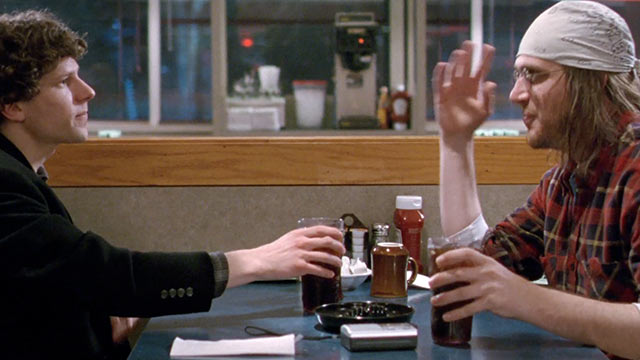
Although Of Course You End Up Becoming Someone Else: A Review of ‘The End of the Tour’
The End of the Tour was never going to escape the David Foster Wallace mystique; the famously expansive author has become paradigmatic of the “tortured artist,” to the point that his literature is now almost inextricable from the tragedy surrounding his life and death. He was (it already seems hard to remember) a flesh-and-blood man, but for better and for worse he embodies an archetype in American culture: the misunderstood genius, the voice of an alienated generation, the lotus flower who was too pure to stay mired in the crudities of this world for very long.
 Adversion